


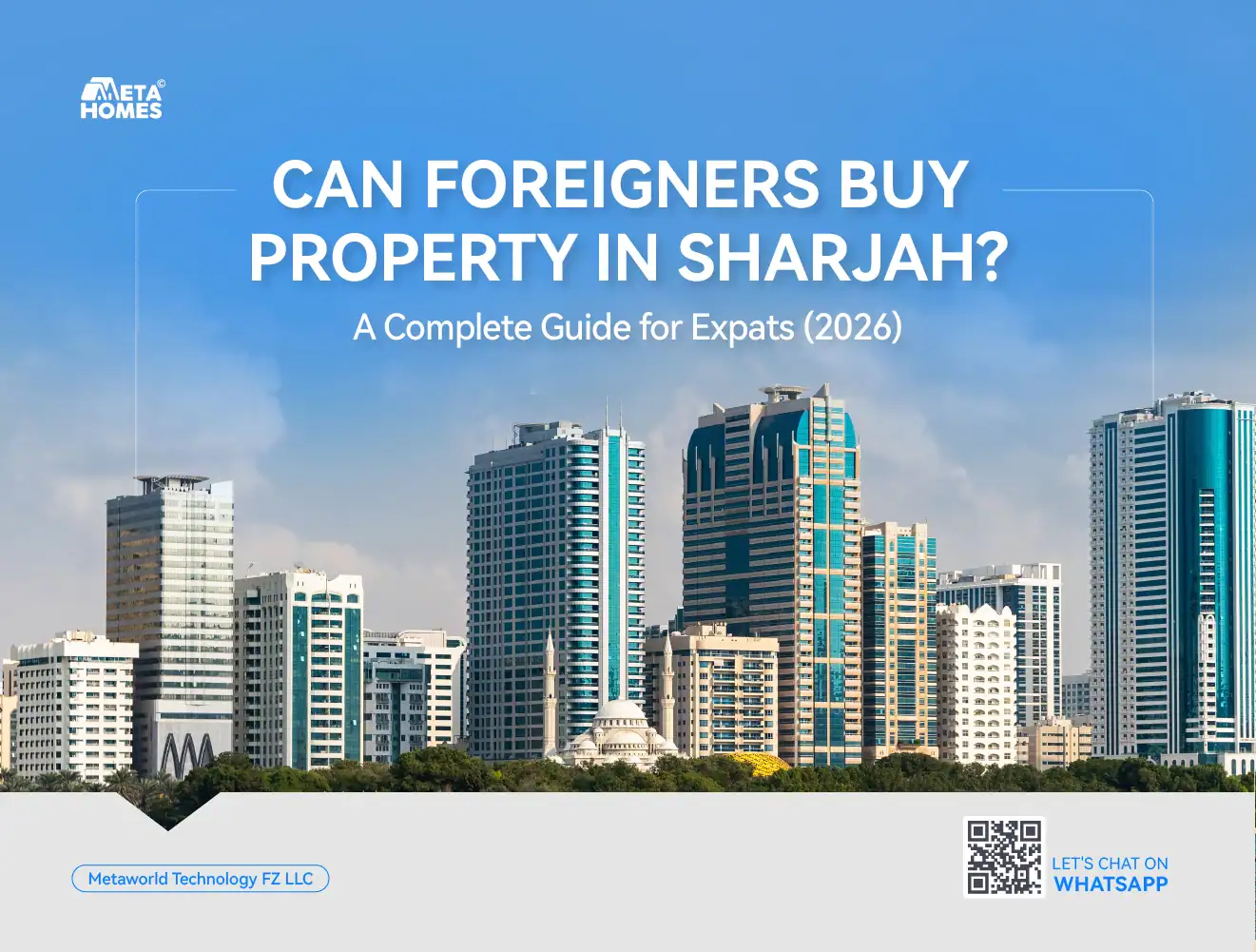
For decades, property ownership in Sharjah was reserved exclusively for UAE and GCC nationals. Expats who had lived in the emirate for ten or twenty years still had no legal route to buying a home or an investment unit. Before the introduction of freehold ownership, most expats could only choose apartments for rent in Sharjah while living in the emirate. Today, eligible buyers can also purchase property in designated freehold communities.
In 2022, the Sharjah government introduced a freehold ownership law in designated developments for buyers of all nationalities, with no requirement to hold a UAE residence visa. The reform gave foreign purchasers full title, registered through the Sharjah Real Estate Registration Department, with the legal right to sell, lease, or pass the property to their heirs.
Ever since the law came into effect, the Sharjah property market has seen unprecedented growth. Sharjah recorded AED 44.3 billion in property transactions during the first nine months of 2025, which was 58% higher than the same period a year earlier and already exceeded the entire 2024 total. International buyers have contributed a growing share of that volume.
This guide covers the ownership regulations that apply to foreign buyers, the developments where purchasing is permitted, current property prices, transaction costs, and the steps involved in buying a property in Sharjah.
Can Foreigners Buy Property in Sharjah?
They can, provided the property is located within one of the designated freehold developments. Sharjah Law No. 2 of 2022 grants non-UAE and non-GCC nationals the right to full freehold ownership in these zones. No single nationality is excluded. An Indian national, a British passport holder, a Filipino resident, or an investor based in Canada all have identical access under the law. There is also no requirement to be living in the UAE at the time of purchase, which opens the market to overseas investors who may not hold any form of UAE residency.
What the law does not allow is unrestricted buying across the emirate. Foreign ownership applies only to developments that have received formal designation from the Sharjah government.
A tower in Al Nahda, a building in Rolla, or a villa in an older neighborhood would not qualify, even if a broker suggests otherwise. Verifying that a property falls within an approved zone through SRERD or the developer should be a non-negotiable step before any money changes hands.
There is also a secondary ownership structure called usufruct, which grants the holder rights to use and occupy a property for up to 100 years. Usufruct agreements are registered, transferable, and inheritable, but the legal framework around them differs from freehold, and buyers considering this route should be clear on what they are agreeing to.
What Changed in Sharjah Property Ownership Laws?
Until 2022, the legal framework governing foreign access to property in Sharjah was built around Law No. 5 of 2010 and a 2014 Executive Council resolution. These laws permitted long-term leasehold and usufruct arrangements, but genuine ownership of the underlying property remained with a local party.
Law No. 2 of 2022 restructured the system in three ways that have direct consequences for foreign buyers. Freehold ownership became available in designated zones, giving the buyer outright title with the freedom to sell, rent, or develop the property without restriction. The residency requirement was eliminated, so buyers no longer needed to hold a UAE visa before purchasing. And the law codified inheritance rights, creating a formal mechanism for foreign owners to transfer property to first-degree relatives.
The outcome, in practical terms, is that a foreign national who purchases properties in Aljada or Maryam Island today receives the same SRERD-issued title deed and holds the same legal standing as a UAE citizen who buys a unit in the same building.
Areas Where Foreigners Can Buy Property in Sharjah
Ownership for foreign nationals is confined to specific master-planned communities that have received government approval. The following are the main developments currently open to international buyers.
Aljada
Aljada covers over 24 million square feet in Muwaileh and is developed by Arada. The community includes apartments, townhouses, and villas alongside retail outlets, restaurants, landscaped parks, and a central retail boulevard. Studio Apartments for sale in Aljada begin at around AED 314,000.
One-bedroom units are generally priced between AED 450,000 and AED 700,000, depending on the specific cluster, floor, and view. Townhouses in the Sarab section of the development start from roughly AED 1.3 million. Aljada sits close to University City, several established schools, and the E311 highway into Dubai, which makes it attractive to families, young professionals, and investors looking at the Muwaileh rental market.
Maryam Island
Maryam Island occupies a waterfront position off the Al Khan coastline and is developed by Eagle Hills. It consists of residential towers with studios and apartments ranging from one to four bedrooms, many of them offering direct sea or lagoon views. A beach club, retail podiums, and a 900-metre waterfront promenade form part of the community infrastructure.
Properties for sale in Maryam Island start from about AED 400,000 for studios, while one-bedroom apartments fall in the AED 450,000 to AED 700,000 bracket. Rental yields across the development average between 5% and 6%. The buyer profile here skews toward investors and working professionals drawn to waterfront living at prices well below what Dubai’s coastal communities command.
Masaar
Masaar is Arada’s second large-scale residential project, built around the concept of nature-focused living. The development incorporates over 50,000 trees, cycling paths, and extensive landscaped parks. Masaar centres on villas and townhouses rather than apartments. Properties for sale in Masaar start from approximately AED 1.8 million for a two- or three-bedroom townhouse. Purchases above AED 2 million meet the threshold for the 10-year UAE Golden Visa.
Located along the Dubai-Sharjah Road, Masaar has drawn interest primarily from families who want outdoor space, greenery, and a residential pace that is quieter than what apartment-focused communities typically offer.
Tilal City
Tilal City takes a more traditional suburban approach, with residential plots and villas laid out across a planned community. Three-bedroom villas in Tilal City average around AED 2.2 million, while four-bedroom homes sit at roughly AED 3.1 million. The development appeals to buyers who want a standalone property with a larger footprint than the townhouse and apartment formats available elsewhere.
Sharjah Waterfront City
Sharjah Waterfront City is a coastal mega project that blends residential, commercial, and recreational components. It is aimed at both investors seeking rental returns and end users interested in seaside living at a cost that remains below comparable Dubai developments. Additional projects may receive approval for foreign ownership as the market expands. Checking the current list with SRERD before beginning any purchase process remains essential.
Types of Properties Foreigners Can Buy in Sharjah
Apartments
Apartments are the most commonly purchased property type among foreign buyers in Sharjah largely because of their lower price point and the strong rental demand that exists across the emirate. If you’re actively looking to invest, browse the latest apartments for sale in Sharjah to compare prices, layouts, and available communities across the emirate.
Studios in developments like Aljada are available from around AED 314,000. A well-positioned one-bedroom unit in a newer tower will generally cost between AED 450,000 and AED 700,000. Two-bedroom apartments in recent projects tend to fall in the AED 860,000 to AED 1.5 million range, while three-bedroom units in premium buildings can reach AED 2.6 million. Shared facilities in most freehold apartment buildings include swimming pools, fitness centres, children’s play areas, covered parking, and round-the-clock security.
Net rental yields after service charges average between 6% and 9% in areas such as Muwaileh and Al Khan, which is a meaningful part of why apartments for sale in Sharjah continue to attract investor interest.
Villas and townhouses
Families looking for larger homes can explore the latest villas for sale in Sharjah, including communities such as Masaar, Tilal City, and Sharjah Waterfront City. Villas and townhouses require a larger financial commitment but provide considerably more living space. Townhouses within Aljada’s Sarab community start from around AED 1.3 million. Villa prices in Masaar begin at approximately AED 1.8 million, and five-bedroom properties in Tilal City can exceed AED 5 million. The buyer profile for villas for sale in Sharjah leans heavily toward families who plan to move into the property.
Most villa layouts include a private garden, parking for at least two vehicles, and proximity to community parks, walking tracks, and green corridors. Growing demand for family-sized rental homes has pushed villa yields upward in recent years, though they still tend to range between 4.5% and 6%, which is below the returns available on apartments.
Off-plan properties
Off-plan properties account for a substantial portion of what is on the market in Sharjah right now, given that several freehold developments are still under construction. Purchasing off-plan usually means securing a unit at a lower price than what completed properties command, with the cost spread across a structured payment plan during the construction period.
A typical off-plan arrangement involves a 10% to 20% deposit at booking, followed by instalment payments tied to construction milestones, with the remaining balance due at handover. The appeal is a reduced entry cost and the prospect of capital appreciation between purchase and completion. The risk is that construction timelines can slip, and the finished product does not always match what was shown in sales materials.
Reviewing the developer’s delivery history on earlier projects and confirming that the development is registered with SRERD should both happen before any contract is signed.
Costs Involved in Buying Property
Beyond the purchase price, several transaction-related expenses apply to property purchases in Sharjah:
| Cost | Typical Amount |
|---|---|
| SRERD registration/transfer fee | 2% to 4% of property value |
| Agent commission | 2% of property value |
| Mortgage registration fee | ~0.25% of loan value |
| Annual service charges | AED 8 to 22+ per sq ft |
| Valuation fee (if mortgaged) | AED 2,500 to 3,500 |
The SRERD registration fee represents the single largest cost after the property price. During the annual ACRES real estate exhibition, the Sharjah government has in previous years offered a 50% discount on this fee, reducing it to 2% of the property value. Buyers who can time their purchase around this event may save a considerable amount, particularly on higher-value transactions. Annual service charges vary widely depending on the age and standard of the building. Older residential towers typically charge between AED 8 and AED 12 per square foot, while newer communities with premium shared facilities tend to charge AED 16 to AED 22 per square foot or more.
Benefits and Considerations for Expat Buyers
The price differential between Sharjah and Dubai is the clearest reason foreign buyers consider this market. A two-bedroom apartment in a well-maintained Sharjah development costs noticeably less than a comparable unit in most of Dubai’s newer residential communities, and the floor areas tend to be larger at every price level.
Rental yields on Sharjah apartments average 6% to 9% net of service charges, driven by stable tenant demand from families, university students, and professionals who commute across the border to Dubai each day. Buyers who purchase property valued at AED 2 million or above become eligible to apply for the 10-year UAE Golden Visa, which also covers immediate family members. The UAE does not levy personal income tax on rental earnings, nor does it impose capital gains tax on the sale of residential property.
Mortgage financing is available to foreign buyers through several UAE banks, among them HSBC, Emirates NBD, Mashreq, and First Abu Dhabi Bank. Loan-to-value ratios for foreign purchasers generally range from 50% to 75%, with non-residents expected to contribute a 25% to 40% down payment. Prevailing interest rates fall between approximately 4.5% and 7.5%, and most lenders require the borrower to demonstrate a minimum gross monthly income of AED 15,000 to AED 25,000.
Step by Step Process for Buying Property
- Select a property within an approved freehold development. Visit the location, evaluate several units, and agree on a price with the developer or a registered agent.
- Confirm that the property is eligible for foreign ownership by verifying its status with SRERD or through the developer.
- Pay the booking deposit to reserve the unit, which is typically between 5% and 10% of the agreed purchase price.
- Execute the sales and purchase agreement. Having a qualified property lawyer review the document is strongly recommended, particularly for off-plan transactions where completion dates, penalty provisions, and handover conditions need close attention.
- Obtain a No Objection Certificate from the developer, which authorises the ownership transfer to proceed.
- Register the transaction with SRERD by submitting a passport copy, Emirates ID where applicable, the executed sales agreement, the developer’s NOC, and proof of all payments made.
- Collect the title deed once SRERD has processed the registration. This step generally takes around 10 working days from the date all documents and fees have been submitted.
Related Articles – Essential Documents for Buying a Property in Sharjah
There are undeniable trade-offs that buyers should weigh. The resale market in Sharjah has less depth and liquidity than Dubai’s, which means selling a property may take longer, particularly if the development is newer or less established. Historical capital appreciation in Sharjah has been more moderate than in Dubai, although recent price growth in the main freehold communities has been stronger than in prior years. The total number of freehold zones open to foreign buyers remains smaller than what Dubai offers. A realistic approach is to plan for a holding period of three to five years or longer, and to treat any shorter-term exit as a possibility rather than an expectation.
As a general estimate, buyers should plan for total transaction costs of 4% to 8% of the property value on top of what they pay for the unit. Confirming all current fees with SRERD before proceeding to completion is advisable, as schedules are subject to periodic revision.
Frequently Asked Questions
Can foreigners buy property in Sharjah?
Yes. Law No. 2 of 2022 permits nationals of all countries to purchase freehold property in designated Sharjah developments. Holding a UAE residence visa is not a prerequisite, and foreign owners retain full rights to sell, lease, or transfer their property to heirs.
Can expats get a mortgage to buy property in Sharjah?
Mortgage products for foreign buyers are offered by several UAE-based banks, including HSBC, Emirates NBD, Mashreq, and First Abu Dhabi Bank. Loan coverage typically ranges from 50% to 75% of the property value. Non-resident buyers are generally required to provide a down payment of 25% to 40%, and qualifying usually requires a gross monthly income of at least AED 15,000 to AED 25,000. Interest rates currently range from around 4.5% to 7.5%.
Which areas in Sharjah allow foreign ownership?
The designated freehold developments currently open to international buyers include Aljada, Maryam Island, Masaar, Tilal City, and Sharjah Waterfront City. The list may grow as new projects receive government approval. Confirming the latest approved developments with SRERD before purchasing is always a prudent step.
Is buying property in Sharjah cheaper than Dubai?
In the majority of cases, Sharjah offers significantly lower prices than Dubai for equivalent property types. A one-bedroom apartment in Aljada, for instance, is typically priced between AED 450,000 and AED 700,000, while a similar unit in a comparable Dubai community would command a considerably higher price. The gap widens further at the villa level. For buyers who do not mind a short commute to Dubai, the cost savings can be substantial.
Can foreign buyers inherit property in Sharjah?
Under current regulations, freehold property in designated zones can be transferred to first-degree relatives through inheritance. The transfer must be formally registered with SRERD, and any change in ownership is required to be reported to the department to maintain legal compliance.
Conclusion
Foreign nationals can purchase property in Sharjah, subject to the condition that the property is located within an approved freehold development. Prices start from around AED 314,000 for studio apartments and extend well into the millions for villas in communities like Masaar and Tilal City. Buyers should budget an additional 4% to 8% of the property value for registration fees, agent commissions, and mortgage-related costs.
Financing through UAE banks is accessible to foreign purchasers who meet the relevant income and down payment thresholds.
What Sharjah offers is a combination of lower entry prices, competitive rental yields, and residential communities designed around families and green space. The limitations are a smaller pool of freehold zones compared to Dubai.




Leave a Reply